Few fixtures in Asian football feel as even as this one. Iran and Japan have been two of the continent’s best teams for decades, and when they meet, the margins are small. A single card, one set-piece, or a coach’s decision about a wing-back can decide it. That is why Iran National Football Team Vs Japan National Football Team Lineups is such a popular search whenever the two sides are drawn together. People want to know who started, who sat out, and what each coach was trying to do.
This article goes through the lineups from the most recent meeting, looks at how the history between the sides has played out, covers where each team is now after the 2026 World Cup, and ends with a table of the last ten meetings and five FAQs.
A Rivalry Built on Close Scores
Iran and Japan first met in 1951, and a lot of football has been played between them since. Their most important meetings have come in Asian Cup knockout rounds and in World Cup qualifying, and the results have rarely been lopsided. One record site counts 20 meetings with 8 Iran wins, 6 Japan wins and 6 draws, while another counts 18 with six wins each and six draws. The different totals come from which matches get counted (Asian Games games, youth sides and so on), but every source agrees on one thing: it has been about as balanced as a rivalry can be.
In the modern era, Japan hold a small edge in the big tournament games. Iran won the most recent one, though, and that match is where the best lineup information comes from.
The Last Meeting: Iran 2–1 Japan, 3 February 2024
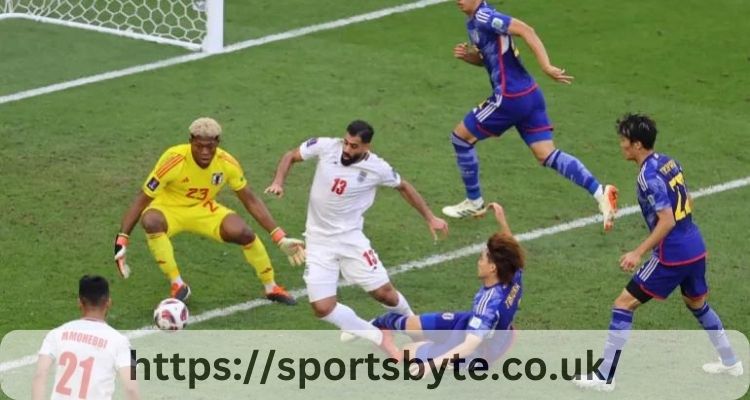
The two sides last played in the quarter-finals of the 2023 AFC Asian Cup, held in Qatar in early 2024. The match was at Education City Stadium in Al Rayyan, in front of a crowd of 35,640. It was a rematch of the 2019 semi-final, which Japan had won 3–0, so Iran had a reason to want this one.
Iran’s starting eleven
According to FotMob, Iran lined up in a 4-2-3-1:
- Goalkeeper: Alireza Beiranvand
- Defence: Ramin Rezaeian, Hossein Kanaani, Shoja Khalilzadeh, Milad Mohammadi
- Defensive midfield: Omid Ebrahimi, Saeid Ezatolahi
- Attacking midfield: Alireza Jahanbakhsh (captain), Saman Ghoddos, Mohammad Mohebi
- Striker: Sardar Azmoun
Iran had no unavailable players listed. Mehdi Taremi, their most dangerous forward, was not in the side, and Sports Mole’s preview had pointed out that Iran might struggle for goals without him.
Japan’s starting eleven
Japan, coached by Hajime Moriyasu, set up in a 4-1-4-1:
- Goalkeeper: Zion Suzuki
- Defence: Seiya Maikuma, Ko Itakura, Takehiro Tomiyasu, Hiroki Ito
- Holding midfield: Wataru Endo (captain)
- Midfield and wide: Ritsu Doan, Takefusa Kubo, Hidemasa Morita, Daizen Maeda
- Striker: Ayase Ueda
Reo Hatate was ruled out through injury.
How the match unfolded
Japan scored first. Morita put them ahead in the 28th minute, and Itakura had picked up a yellow card four minutes before that. Iran trailed 1–0 at the break. Mohebi equalised in the 55th minute from a pass by Azmoun. Ueda had been booked at 48′, and Japan could not find a second goal. Then, in the sixth minute of stoppage time, Jahanbakhsh converted a penalty to win it for Iran 2–1.
The substitutions were late. Japan brought on Mitoma for Kubo and Minamino for Maeda around the hour mark, then Asano for Doan and Hosoya for Morita in stoppage time. Iran waited until the end of normal time and used Cheshmi, Torabi and Ansarifard as replacements for Ghoddos, Mohebi and Azmoun.
Predicted vs actual: a useful reminder
This match is a good example of why preview lineups should not be treated as fact. Sports Mole’s preview predicted Iran would start Cheshmi, Hajsafi, Torabi, Ansarifard and Ghayedi, but the actual lineup used Kanaani, Mohammadi, Ebrahimi, Jahanbakhsh, Ghoddos and Mohebi instead. On the Japan side, the preview guessed Nakayama, J. Ito, Minamino and Kubo. In the end Hiroki Ito, Morita, Maeda and Doan were picked. If you are writing about Iran National Football Team Vs Japan National Football Team Lineups, always use the confirmed teamsheet and not the preview.
The Match Before That: Japan 3–0 Iran, 28 January 2019
The previous meeting was the 2019 Asian Cup semi-final in the United Arab Emirates, and it was one-sided. Japan won 3–0 at the Hazza bin Zayed Stadium in Al Ain. Yuya Osako scored twice and Genki Haraguchi got the other. It was a real setback for an Iranian team that had been the continent’s top-ranked side at the time.
I could not find a reliable full lineup for that game in the sources I checked, so I will not guess at it. The result still matters, because it explains why the 2024 win meant something to Iran: it was a return match with something to prove.
Last 10 Head-to-Head Meetings (Table)
Here are the last ten senior men’s meetings that I could confirm across several records.
| # | Date | Competition | Home team | Score | Away team | Venue |
|---|---|---|---|---|---|---|
| 1 | 3 Feb 2024 | AFC Asian Cup, quarter-final | Iran | 2–1 | Japan | Education City Stadium, Al Rayyan |
| 2 | 28 Jan 2019 | AFC Asian Cup, semi-final | Iran | 0–3 | Japan | Hazza bin Zayed Stadium, Al Ain |
| 3 | 13 Oct 2015 | International friendly | Iran | 1–1 | Japan | Azadi Stadium, Tehran |
| 4 | 17 Aug 2005 | World Cup qualifier | Japan | 2–1 | Iran | Nissan Stadium, Yokohama |
| 5 | 25 Mar 2005 | World Cup qualifier | Iran | 2–1 | Japan | Azadi Stadium, Tehran |
| 6 | 28 Jul 2004 | AFC Asian Cup, group stage | Japan | 0–0 | Iran | Chongqing Olympic Sports Center |
| 7 | 8 Sep 1999 | Kirin Cup (friendly) | Japan | 1–1 | Iran | Not confirmed |
| 8 | 16 Nov 1997 | World Cup qualifier (play-off) | Japan | 3–2 (a.e.t.) | Iran | Not confirmed |
| 9 | 18 Oct 1993 | World Cup qualifier | Japan | 1–2 | Iran | Not confirmed |
| 10 | 3 Nov 1992 | AFC Asian Cup | Japan | 1–0 | Iran | Not confirmed |
Across these ten games, Japan have won four, Iran three, and three finished level. Goals are close too: Japan 14, Iran 11. A note on the data: one site also lists a November 2010 meeting (Iran 1–2 Japan), but that appears to have been a youth-level or Asian Games fixture, so I left it out. The two 2005 results come from FBref and the FIFA ranking site, and one other site shows them differently, so check an official source if you need exact venues for a published piece.
Where Each Team Stands Now
Iran
Iran played at their seventh World Cup in 2026, in a tournament that was far from normal for them. Coach Amir Ghalenoei said before and during the finals that his team’s preparation had been badly affected by the conflict between Iran and the United States, which hosted most of the tournament. On the pitch, Iran drew all three group games: 2–2 with New Zealand, 0–0 with Belgium, and 1–1 with Egypt. Three points left them third in Group G, and they missed out on the eight best third-placed spots by a narrow margin.
In the build-up, Iran had beaten Gambia 3–1 on 29 May and Mali 2–0 on 4 June, both in Antalya, Turkey. Earlier results had been less convincing, including a 2–1 defeat to Nigeria in March and a penalty shoot-out loss to Uzbekistan in November 2025. FotMob lists Iran at 20th in the FIFA ranking, with Ghalenoei still the head coach.
The core of the squad is familiar: Beiranvand in goal, Rezaeian and Mohammadi at the back, Ezatolahi in midfield, and Taremi and Azmoun up front, with Jahanbakhsh still around. That experience helps, but the squad is ageing.
Japan
Japan’s year was stronger. Moriyasu’s team beat both Scotland and England 1–0 away in March 2026, then beat Iceland 1–0 at home on 31 May. At the World Cup they were in Group F, drawing 2–2 with the Netherlands, beating Tunisia 4–0, and drawing 1–1 with Sweden. That was enough to reach the round of 32. There they lost 2–1 to Brazil, with Kaishu Sano scoring first, Casemiro equalising, and Gabriel Martinelli getting the winner in stoppage time.
Japan’s captain Wataru Endo withdrew injured on the first day of the tournament, and Ko Itakura wore the armband. Since the World Cup, Japan have beaten Uruguay 3–1 in a September friendly. They are ranked 19th by FotMob. Hajime Moriyasu has been in charge since 2018.
One notable difference from 2024: the Japan side now has more attacking options than it did two years ago. Daichi Kamada and Ayase Ueda each scored twice at the World Cup, and Keito Nakamura, Junya Ito, Daizen Maeda and Kaishu Sano all featured.
Tactical Differences You Can See in the Lineups
Looking at the teamsheets, a few patterns are worth noting.
Iran build from the back and rely on wide runners. In 2024 the 4-2-3-1 used two holding midfielders, Ebrahimi and Ezatolahi, to protect the back four and free up Ghoddos to play between the lines. Jahanbakhsh and Mohebi stayed wide, with Azmoun as the target. It is a compact system that lets Iran stay organised without the ball.
Japan prefer movement in midfield. The 4-1-4-1 put Endo in front of the centre-backs, with Morita and Kubo drifting inside and Doan and Maeda running at defenders. The idea was to overload the central areas. It worked in the first half, but Japan struggled to create clear chances after Iran changed their shape at half-time.
Substitutions mattered, and they came late. Both coaches left their changes until the closing minutes in 2024. Japan’s best attacking substitutes, Mitoma and Minamino, came on at about 67 minutes, and neither could turn the game. Iran waited until stoppage time, and the penalty came before their changes had any effect.
Set pieces and penalties decide these games. Of the last three Iran–Japan matches, only the 2019 game was clear-cut. Both the 2015 draw and the 2024 result turned on small moments.
What a Future Lineup Might Look Like
There is no confirmed date for the next Iran–Japan match that I could find. If one comes up, here is a reasonable guess at what each side might do.
Iran are likely to keep a 4-2-3-1 or a 4-1-4-1, with Beiranvand in goal and Kanaani and Khalilzadeh in defence, if they are still available. Ezatolahi should hold the midfield. Up front, Taremi and Azmoun would be the first choices if fit, with Jahanbakhsh and Mohebi on the flanks. A new generation is starting to appear, and the World Cup showed how much Iran rely on a handful of senior players.
Japan will probably stay with a back four and a single holding midfielder, though Moriyasu has also used back-three systems in recent years. Suzuki is the first-choice goalkeeper, Itakura and Tomiyasu lead the defence, and Endo returns in midfield when fit. In attack he has plenty to choose from: Kubo, Mitoma, Doan, Kamada, Ueda and Maeda.
If the two meet in a knockout match, expect cautious starts, as both sides know how close the games tend to be.
Where to Find Confirmed Lineups
Official teamsheets are normally released about an hour before kick-off. The most reliable places to check are the AFC and FIFA match pages, the federation accounts (the Japan Football Association and the Football Federation Islamic Republic of Iran), and established match-data sites such as FotMob, ESPN and FBref. Treat anything labelled “predicted” or “probable” as a guess.
Final Thoughts
The story of Iran National Football Team Vs Japan National Football Team Lineups is one of small differences. Both teams have deep squads for Asian football, both usually field settled sides, and both have lost to the other by narrow scores. The record shows this: three wins each, three draws and a goal difference of three across the last ten meetings.
The 2024 quarter-final showed how a match between them can turn in the last minute. Japan controlled long periods and still lost. Iran were behind for most of the game and still won. After a World Cup in which neither side got beyond the round of 32, both coaches will be looking at which of their players can carry them to the next big tournament. When Iran and Japan do meet again, the teamsheets will be worth reading closely.
Frequently Asked Questions (FAQs)
1. When did Iran and Japan last play each other?
They last met on 3 February 2024, in the quarter-finals of the AFC Asian Cup in Qatar. Iran won 2–1 at Education City Stadium. Morita scored for Japan, and Mohebi and a stoppage-time penalty from Jahanbakhsh gave Iran the win.
2. What were the Iran and Japan lineups in that match?
Iran started Beiranvand; Rezaeian, Kanaani, Khalilzadeh, Mohammadi; Ebrahimi, Ezatolahi; Jahanbakhsh, Ghoddos, Mohebi; Azmoun. Japan started Suzuki; Maikuma, Itakura, Tomiyasu, Ito; Endo; Doan, Kubo, Morita, Maeda; Ueda.
3. What is the head-to-head record between Iran and Japan?
It depends on which matches a source counts. Records list roughly 18 to 20 meetings, with wins nearly evenly split between the two. In the last ten matches I could confirm, Japan won four, Iran won three and three were drawn.
4. How did Iran and Japan do at the 2026 World Cup?
Iran drew all three group games (New Zealand 2–2, Belgium 0–0, Egypt 1–1) and went out in the group stage. Japan drew with the Netherlands, beat Tunisia 4–0, drew with Sweden, and lost 2–1 to Brazil in the round of 32.
5. When will Iran and Japan play next?
I could not find a confirmed fixture between them. If one is scheduled, it will be announced by the AFC or the two federations, so check their official channels for the latest information.