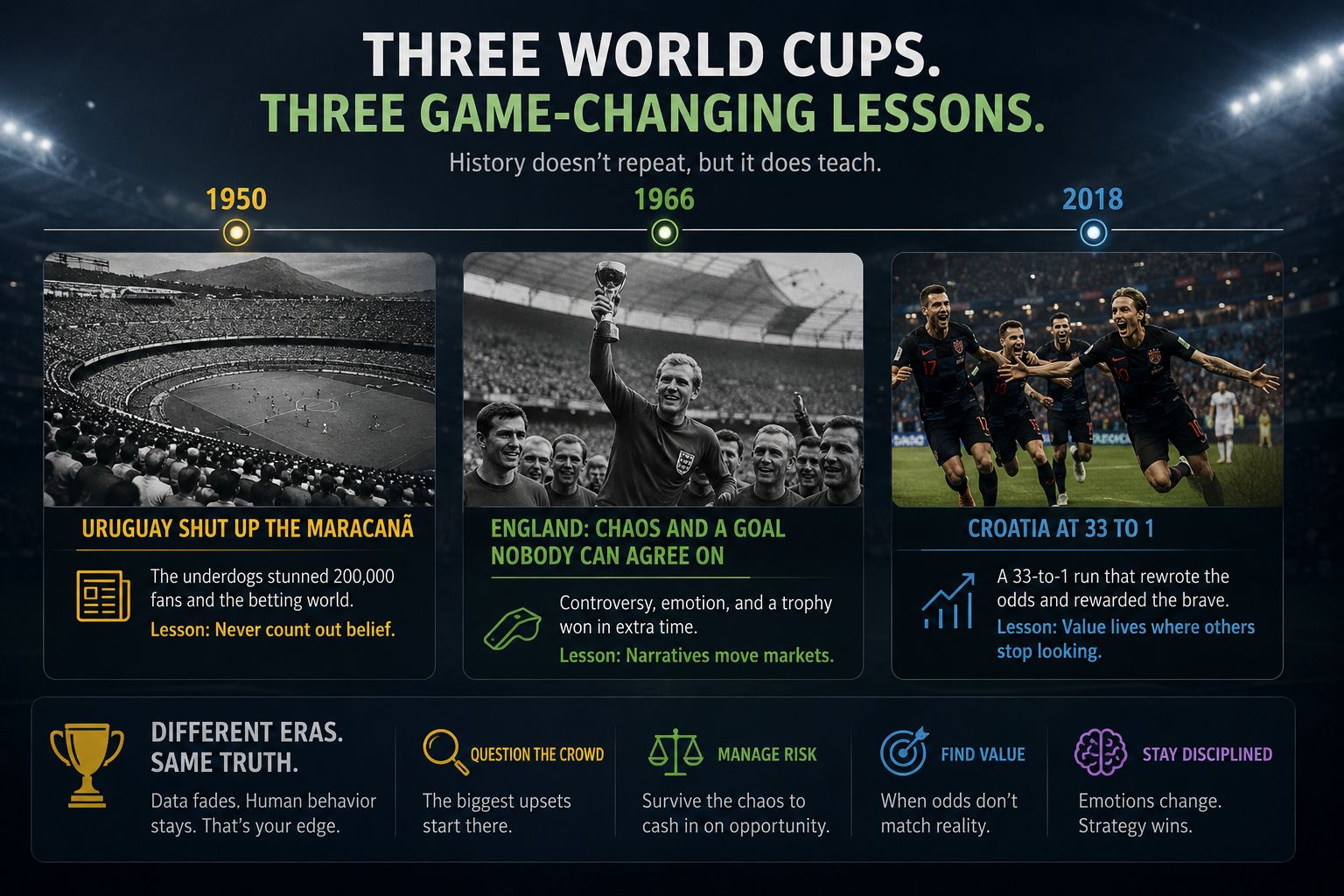
Every World Cup spits out a trail of numbers. Goals tallied, cards handed out, gates counted, odds flipped. Some tournaments just nudge history a little. Others wreck betting markets and force you to rethink what risk actually means. Three editions stick out — for the sheer shock, the data they left behind, and the way they still echo today.
1950 — Uruguay shut up the Maracanã
Brazil hosted the first World Cup after the war. For the final round, Rio put all into building the Maracanã. 173,850 people were officially counted as paid spectators for the decider. When you include the gate-crashers, the figure approaches 200,000.
There was no actual final. Four teams sat in a group, and whoever topped it won the whole thing. Brazil just needed a draw against Uruguay on July 16. Newspapers back home had already printed the celebration headlines before anyone kicked a ball.
British bookmakers had Brazil sitting around 1.40. Uruguay was out near 8.00. Almost nobody touched the visitors. Brazil had ripped through the earlier group games with 13 goals. Uruguay? A draw with Spain and a narrow win over Sweden.
Schiaffino put Uruguay ahead in the second half. Brazil pulled level. A draw still handed it to the hosts. Then Ghiggia hit it in the 79th minute. Uruguay took it 2-1. The stadium went dead quiet.
The takeaway is simple. If you just pile on favorites without caring about the price, this game is your warning. Everyone’s money was on Brazil, so the odds had no real value. The underdog price was where the edge lived. A modest bet at 8.00 paid out eight times over. Big favorites come with weight. That weight changes things.
1966 — England: chaos, and a goal nobody can agree on
England went into that tournament at 9 to 2 with several UK bookies. Playing at home did that. No host had lifted the trophy since Italy in ’34 and ’38, and England had never won it at all.
Wembley hosted the final against West Germany. It was 2-2 in extra time. In the 101st minute, Hurst cracked one off the bar, and it bounced down. Soviet linesman Tofiq Bahramov waved it in. Referee Gottfried Dienst went with it. England went up 3-2 and eventually won 4-2.
There was no tech to settle it. In 2016, the Fraunhofer Institute ran 3D models and concluded the ball never fully crossed the line. The argument still shows up in documentaries and betting forums.
So what does this mean for someone who places bets?
Home advantage doesn’t just help the crowd — it nudges referees too. Data from 1930 through 2018 shows hosts pick up fewer yellow cards on average. In that final, England fouled 11 times. West Germany fouled 33. The whistle shaped the game.
2018 — Croatia at 33 to 1
Russia 2018 gave us one of the juiciest underdog runs in recent World Cup betting. Croatia opened at 33 to 1 with the big online bookmakers. France was around 6 to 1. Brazil and Germany soaked up most of the early cash.
Croatia topped Group D with nine points, then the knockout madness started. Three matches in a row went to extra time. Two were settled on penalties. On paper, the squad looked thin. Modrić, Rakitić, and Mandžukić were logging enormous minutes.
Every extra time a game sent live betting into a frenzy. Due to the widespread belief that Croatia had been gassed, opponents frequently began to show partiality in the latter stages. Mandžukić scored the game-winning goal in extra time after Perěić tied England in the semifinals. Before the tournament even began, anyone who had acquired Croatia at 33 to 1 was sitting on a huge hedge.
The final was won 4-2 by France. Croatia nevertheless produced one of the greatest each-way payouts in recent memory. If paid in full, a hundred dollars at a 33 to 1 ratio produced 3,300 in profit. You could lock in risk-free money either way because several bookmakers offered cash-out prior to the final.
Final Words
Three tournaments, three wildly different routes into the history books. Uruguay stunned a crowd of almost 200,000 inside one ground. England hoisted their first trophy in the middle of an argument that still won’t die. Croatia turned 33 to 1 into a masterclass in finding value. Let’s see what the 2026 tournament is going to bring.