From shrewd strategists to drillmasters, every winning team has a crew of staff working non-stop behind the scenes. Here’s a look at the Team India Head Coach and some of India’s coaches over the years.
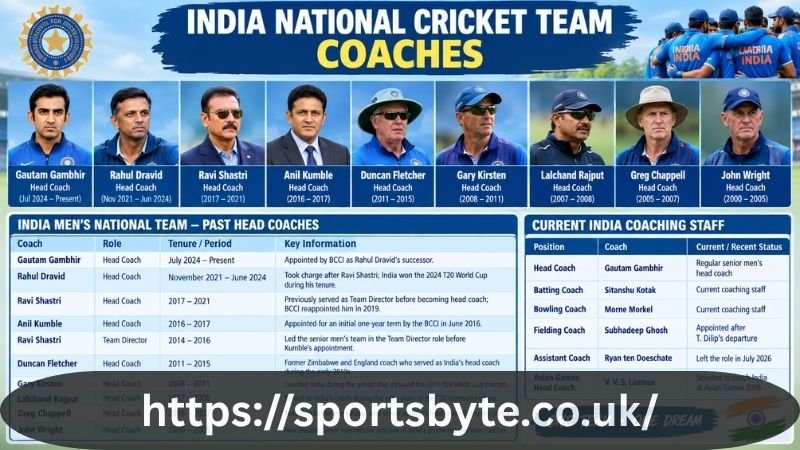
Gautam Gambhir is the latest name on the list, taking over as India’s coach after Rahul Dravid’s tenure ended at the T20 World Cup. The left-handed batter was previously mentor of IPL side Kolkata Knight Riders.
Bishan Singh Bedi
During his playing days, Bedi was a graceful spinner who took over 1560 wickets in first-class cricket. He was also a good batsman and a fine administrator.
During his tenure as full-time coach of the Indian cricket team, he was known to be a strict disciplinarian. He was also a man of strong principles. He once famously threatened to dump the team in the Pacific Ocean after a disastrous tour.
He played for Northern Punjab and Delhi in domestic cricket before making a name for himself in the Test arena with his miserly economy. The spinner would deceive batsmen with his natural gifts of flight and guile, while never being afraid to speak up against contentious issues in the game.
One of his most famous battles was against Muttiah Muralitharan, who he called a ‘chucker’. He even tried to invoke the ICC’s anti-chucking rule against him. However, the governing body refused to do so.
Abbas Ali Baig
Abbas Ali Baig is an experienced manager who has helped India to a number of victories in recent times. He will be looking to improve India’s performance at ICC tournaments abroad and ensure they are competitive across all formats. His appointment as coach comes amid high expectations. He must balance youth with experience and ensure the team peaks at important moments.
In the 1970s and 1990s, the job of coach was a rotating position that often changed between former players. A few coaches, such as PR Man Singh and Rahul Dravid, coached the national side on more than one occasion.
However, it was not until 2000 that India began hiring foreign coaches on longer tenures. Wright, Kirsten, Fletcher, and Shastri all stayed for five years or more. This allowed them to shape the culture and implement new ideas. It also allowed the coaches to plan ahead and set long-term goals for the squad.
Bishan Singh Wadekar
Despite his lack of success as a batsman Bish Bedi had a ferocious temper and was often critical of the game’s ruling bodies. In 1976 he declared India’s second innings early at Kingston to protest hostile bowling by West Indies fast bowlers. He later slammed Muttiah Muralitharan’s bowling action and refused to play in Kerry Packer’s World Series Cricket.
Bedi was a fine coach, and during his time in charge of the Indian team he led them to three Test wins in England. However, early on during the 1974 tour of the West Indies there was a flaming row between him and the captain Ajit Wadekar over a series of interviews that Bedi had given.
This was probably not in breach of contract, but it did give an unfavorable impression to the media and perhaps contributed to the team’s poor performance. Bedi was replaced in the six-Test series with Sunil Gavaskar.
Kapil Dev
Kapil Dev is a household name in India, where he’s considered one of the greatest cricketers of all time. He’s renowned for his fearless leadership and all-round brilliance with both bat and ball.
He led the Indian team to its first World Cup victory in 1983, a moment that reshaped the nation’s sporting identity and instilled an enduring sense of pride among the people.
He played his first Test match for India in October 16, 1978, against Pakistan in Faisalabad. He quickly became known as a fast bowler who could also contribute with the bat. His all-round skills made him a key part of the Indian side throughout the 1970s and 1980s.
His stint in county cricket with Northamptonshire and Worcestershire helped him refine his skills and gain experience in varying playing conditions. This likely aided his strategic understanding and ability to adapt in international cricket. His captaincy was hampered by reports of differences with Sunil Gavaskar but the pair eventually reconciled, maintaining integrity and collaboration for Indian cricket’s success.
John Wright
Gautam Gambhir, the man known for his gritty batting and strategic insight, has been appointed as the new team india head coach. He replaces Rahul Dravid, who stepped down following the team’s win in the 2024 T20 World Cup. BCCI secretary Jay Shah made the announcement on social media, praising Gambhir’s dedication and understanding of modern cricket.
Wright was also the coach for Kolkata Knight Riders and New Zealand national team. He is a renowned cricket strategist who has guided several teams to success. He has recently written a book on his experiences as a national cricket coach, which is available for purchase.
The book is a collection of personal notes and a look at the coaching philosophies of Wright. He is adamant that his book is accurate. He has also denied the allegations of dumping players to please someone. Subscribe to The Cordon on iTunes, TuneIn Radio or YouTube Channel.
Greg Chappell
Gregory Stephen Chappell, also known as Greg, is an Australian former cricketer. He played 87 Test matches for Australia and captained them 48 times. He is a highly respected commentator and has worked for Channel Nine, Optus Sports vision, World Tel, and ESPN. He was also a member of the Australian cricket selectors for five years from 1984-89 and again in 2010-11.
He is also an acclaimed author who writes on the sport of cricket and other topics such as health, fitness and lifestyle. After retiring from the game, he became involved in politics and served as an elected lawmaker for India’s Hindu nationalist Bharatiya Janata Party until he quit the job in March 2024 to coach IPL team Kolkata Knight Riders.
In his new role, he will take charge of a national team that has high expectations after winning the T20 World Cup last month. He is expected to bolster the batting department and encourage an aggressive approach in both formats of the game.
David Fletcher
Having led the Indian cricket team to a record-setting ODI and Twenty20 World Cup title, Gautam Gambhir is set to take over as India’s new white-ball coach. He replaces Rahul Dravid, and is expected to build on the foundation that his predecessor laid.
Gambhir will no doubt come under scrutiny for the team’s poor showing in England, but he is well aware that one poor tour shouldn’t define a coach. ICC trophies have long been the yardstick against which coaches have been judged, and Gambhir has an unblemished record there.
Aditya Bhattacharya is the Sports Editor at Hindustan Times Digital. He has close to 15 years of experience in sports journalism. He has previously worked for Cricbuzz, The Times of India and Network18. He is also a graduate assistant in the men’s soccer program at St. John’s University. He has covered major marquee events, from cricket to tennis. He currently resides in West Palm Beach, Florida.
Ravi Shastri
He was a good middle order batsman who had the ability to score big runs in important matches. He also bowled a bit of left arm spin. He was a good team man who could handle pressure very well. He was a highly respected player and also an excellent commentator on the game of cricket.
He captained India for one Test match against England in 1984. He replaced the injured Vengsarkar in a drawn Test at Madras. In his innings, he scored a hundred and also shared an unbeaten 188-run partnership with Srikkanth.
Towards the end of his career, he was a regular opening partner for Sunil Gavaskar in one day internationals. He also opened with him in two matches of the World Cup at Sydney. He took five wickets for 15 runs in that match, which was the best return by an Indian in ODIs at that time. He was a highly committed batsman who played the game with great spirit and dedication.
Anil Kumble
A prominent intersection on Mahatma Gandhi Road in Bangalore is called the Anil Kumble Circle. It’s not hard to see why.
It was during the early 1990s that the world woke up to the mighty Anil Kumble. He sent down deliveries that were a challenge for batsmen to negotiate. He did it at home, but more spectacularly on unresponsive foreign pitches. His ODI debut against Zimbabwe saw him romp to a six-wicket haul, while his Test debut against the West Indies at Kotla saw him send down 13 wickets.
Those days are long gone. The world has moved on, and Kumble has witnessed that change from the sidelines. However, his experience and knowledge of the game remain valuable in understanding the responsibilities of the Team India Head Coach. His achievements as a player and his strategic insight have helped him contribute to Indian cricket in a coaching role.
Also Read : Highest Women’s Odi Score